9 Best Bank Check OCR Converters in 2026

9 Best Bank Check OCR Converters in 2026
Bank check OCR is still worth comparing because checks are declining in count but remain high-value documents. The Federal Reserve Payments Study reported 11.2 billion US check payments in 2021, with an average value of about $2,430 per check. That makes extraction mistakes expensive.
The best bank check OCR converter depends on what you're building. A finance team converting checks to spreadsheets needs a different product than a bank embedding mobile remote deposit capture. A developer building a custom payment workflow may need a MICR SDK instead of a full document automation platform.
Key Takeaways
- The Fed reported 11.2 billion US check payments in 2021, so check OCR still matters.
- Choose specialist check OCR for MICR, CAR/LAR, fraud, and RDC workflows.
- Choose Suparse when the goal is fast check-to-Excel, Sheets, CSV, JSON, or API extraction.
- Treat 97-99.9% vendor accuracy claims as test hypotheses, not proof.
Most comparison pages mix three different markets: document management systems, bank-grade check processing engines, and OCR APIs. That creates bad buying advice. This guide separates them by workflow, then ranks tools by check-specific extraction, deployment model, review controls, and export usefulness.
What Is the Best Bank Check OCR Converter in 2026?
The best overall bank check OCR converter for business operations is Suparse, because it starts with a dedicated bank check extraction workflow and a 50-page free test path (Suparse Bank Check OCR, 2026). Banks with RDC or fraud requirements should shortlist OrboGraph, Parascript, and Mitek instead.
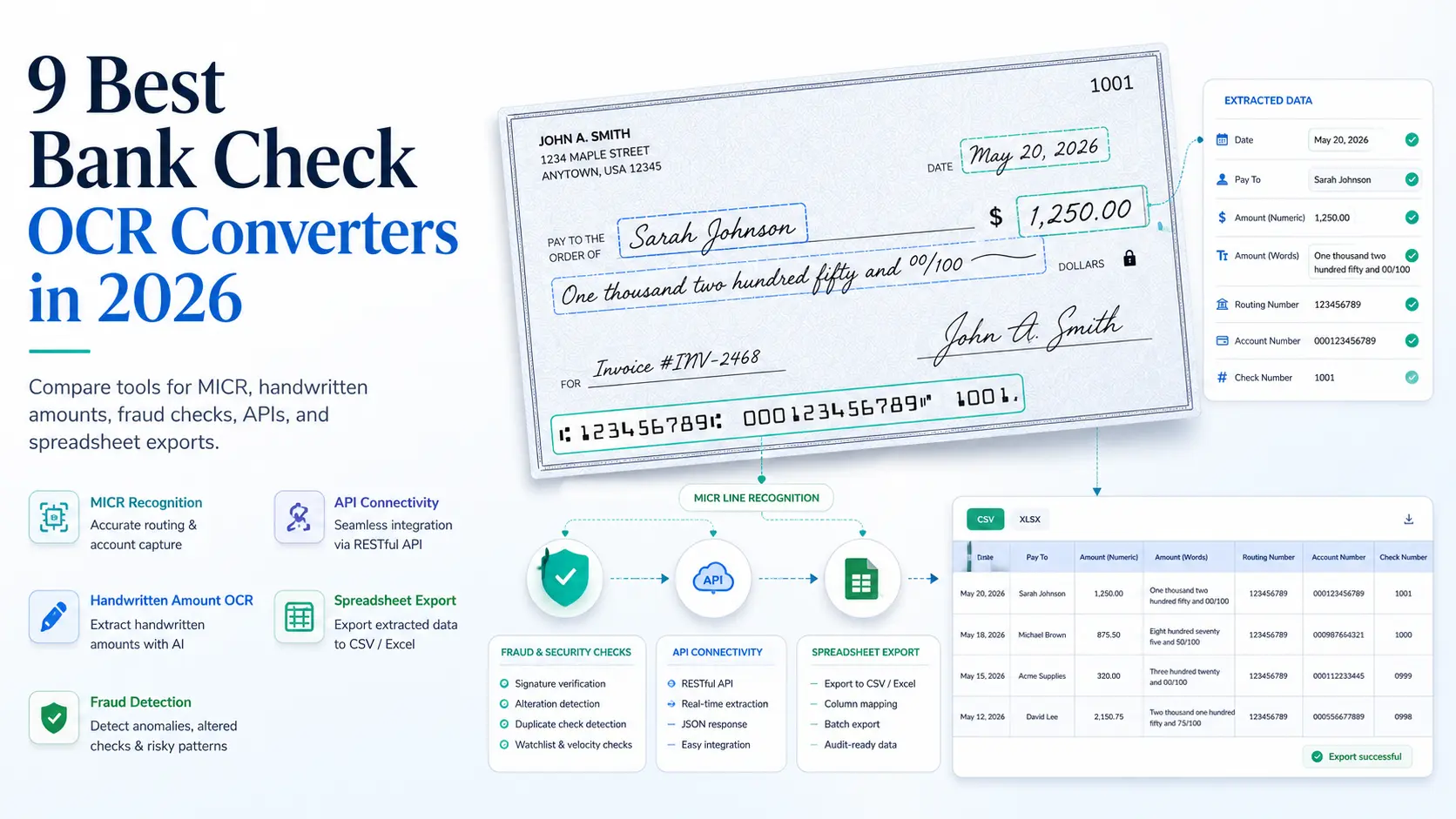
Bank check OCR should extract the MICR line, routing number, account number, check number, numeric amount, written amount, date, payee, drawer, memo, and signature presence. The hard parts are not just OCR. They are MICR validation, handwritten amount reading, image-quality control, and exception review before data enters accounting or payment systems.
Suparse is the best fit when you want to upload checks and export structured data to Excel, Google Sheets, CSV, JSON, or an API. It also fits teams that process checks alongside invoices, receipts, bank statements, and tax forms in one financial document extraction workflow.
Specialist bank vendors win when the check image itself is part of a regulated deposit, fraud, or proof-of-deposit process. OrboGraph and Parascript are stronger fits for banks and lockbox processors. Mitek is stronger for mobile deposit capture. MICR SDKs such as Doubango, LEADTOOLS, and GdPicture are better when developers want to embed low-level MICR recognition into their own stack.
Bank check OCR buyers should evaluate tools by field-level error rate, not by generic OCR accuracy. A converter can read the payee correctly and still fail the workflow if it misreads one digit in the routing number. That is why check-specific testing beats vendor brochures.
Quick Comparison of the Best Bank Check OCR Converters
Microsoft documents a dedicated prebuilt-check.us bank check model, while many general OCR platforms still require custom check logic (Microsoft Learn, Document Intelligence bank check model, 2026). That split explains why this table separates converters, RDC platforms, and MICR SDKs.
| Tool | Best For | Check-Specific Strength | Deployment | Pricing Signal |
|---|---|---|---|---|
| Suparse | Finance teams converting checks to spreadsheets or API data | MICR, amounts, payee, drawer, dates, memo, review, exports | Cloud SaaS + API | Free test, $11 for 100, from $36 per 1,000 pages/month with annual billing on the 10,000-page plan |
| Veryfi | Mobile check capture API workflows | Check OCR API, Lens capture, fraud and duplicate signals | Cloud API + mobile SDK | Quote-based |
| Azure Document Intelligence | Azure teams needing a prebuilt check API | Dedicated US bank check model | Cloud API + containers | Public per-page pricing |
| OrboGraph OrboAnywhere | Banks, lockbox, teller, ATM, RDC operations | CAR/LAR, validation, compliance, fraud | Enterprise platform | Enterprise quote |
| Parascript CheckUltra / CheckPlus | Proof-of-deposit and bank item processing | MICR, CAR/LAR, signature checks, image integrity | On-prem / OEM | Enterprise quote |
| Mitek Mobile Deposit | Banking apps with mobile RDC | Device-side check capture and deposit flow | Mobile SDK / platform | Enterprise quote |
| Doubango ultimateMICR | Developers embedding MICR recognition | E-13B and CMC-7 MICR extraction | Native SDK | SDK licensing |
| LEADTOOLS MICR SDK | .NET, Java, C/C++ document apps | MICR plus image cleanup and OCR tools | SDK | SDK licensing |
| GdPicture MICR SDK | .NET teams needing MICR extraction | E-13B and CMC-7 MICR recognition | SDK | SDK licensing |
This comparison intentionally excludes broad document repositories that mention check scanning but do not expose strong check-specific extraction details. They may store check images well. They are not always the best OCR engine for MICR, handwritten amounts, or fraud-sensitive processing.
According to the Federal Reserve's 2022 payments study, US check payments still represented about $27.23 trillion in value in 2021. A bank check OCR workflow should therefore be judged on exception reduction and downstream correctness, not only on scan speed or document storage.
1. Suparse - Best Bank Check OCR Converter for Finance Teams
Suparse offers a bank check OCR landing workflow with 50 free pages and exports to Excel, Google Sheets, CSV, and JSON (Suparse Bank Check OCR, 2026). It is the best first test for teams that want check data in usable business formats quickly.
Suparse extracts MICR line data, routing numbers, account numbers, check numbers, numeric and written amounts, payee names, drawer details, dates, memos, and bank names. It is built for document operations where accuracy review and clean export matter as much as OCR itself.
The main advantage is workflow breadth. You can process checks alongside bank statements, invoices, receipts, and other financial document extraction use cases. That matters for accounting teams that don't want one tool for checks and another for every surrounding document.
When we evaluate financial document OCR, the real bottleneck is rarely extraction alone. It is the handoff into spreadsheets, accounting systems, or review queues. A check converter that returns structured, editable fields is more useful to finance teams than a raw text OCR engine with a higher lab score.
Best for: accounting teams, AR teams, bookkeepers, finance ops, and small-to-mid-sized businesses that need checks converted into structured data without building a custom capture pipeline.
Watch out for: bank-grade RDC, signature verification, and fraud scoring requirements. If the check image becomes a regulated deposit item, evaluate bank-focused platforms too.
2. Veryfi - Best Check OCR API for Mobile Capture
Veryfi documents bank check extraction fields including MICR, routing, account, and check numbers through its Checks OCR API (Veryfi Checks MICR Fields, 2026). It is a strong fit when developers need a mobile-first API rather than a spreadsheet-first workflow.
Veryfi combines OCR with mobile capture guidance through its Lens product. That helps reduce bad images before the OCR engine sees them. For mobile checks, this matters because glare, skew, shadows, and partial cropping can break otherwise capable extraction models.
Veryfi's public materials emphasize routing numbers, account numbers, check numbers, payee data, amount fields, duplicate detection, and fraud scoring. Those are the right primitives for fintech apps, payment flows, and embedded finance products that need structured check data through APIs.
The tradeoff is commercial transparency. Like many specialist check OCR vendors, Veryfi does not publish a simple commodity price table for every check use case. Teams should request a quote and test against their own image mix before committing.
Best for: fintech developers, mobile capture workflows, and teams building check capture inside an app.
Watch out for: teams that primarily want nontechnical spreadsheet exports. Suparse will usually be faster to test for that workflow.
3. Azure Document Intelligence - Best General Cloud OCR With a Check Model
Azure Document Intelligence provides a dedicated US bank check model, prebuilt-check.us, and Microsoft states that model version 4.0 supports check extraction and signature detection (Microsoft Learn, 2026). That makes Azure the strongest hyperscaler option for check-specific OCR.
Azure is attractive when your data stack already runs on Microsoft services. It returns structured JSON with bounding regions and confidence signals, and it can be integrated into Power Automate, Azure Functions, queues, storage, and downstream validation services.
The weakness is product completeness. Azure gives you a model and infrastructure, not a ready finance operations interface. You still need to design review screens, rejection rules, exports, routing validation, and business logic for amount reconciliation.
Azure's pricing page publishes document intelligence pricing by page and tier, which makes cost modeling easier than enterprise-only vendors (Azure AI Document Intelligence pricing, 2026). For developers, that transparency is useful before a proof of concept.
Best for: Azure-native engineering teams that want a check-aware OCR API and can build the workflow layer themselves.
Watch out for: nontechnical teams. A managed API is not the same thing as a finished check conversion product.
4. OrboGraph OrboAnywhere - Best for Check Recognition and Fraud
OrboGraph advertises 99%+ read rates and 99.5%+ CAR/LAR/ICR accuracy for its OrbNet AI check recognition stack (OrboGraph, AI-Based Check Recognition, 2026). Treat those as vendor-reported claims, but OrboGraph is clearly positioned for bank-scale check processing.
OrboAnywhere is not just a converter. It is a payment automation and fraud platform for teller capture, ATM, RDC, lockbox, and retail remittance channels. That makes it more relevant to banks, processors, and enterprise remittance operations than to small teams that just want check data in a spreadsheet.
The platform's strength is the pairing of recognition and risk context. It supports check recognition, validation, compliance workflows, image-forensics fraud detection, and payor/payee screening concepts. Generic OCR tools usually stop long before that point.
The downside is complexity. OrboGraph is an enterprise platform, so buyers should expect sales-led pricing, implementation planning, and integration work. That is appropriate for high-volume, high-risk check flows. It is excessive for basic OCR conversion.
Best for: banks, credit unions, lockbox processors, and fraud-sensitive payment operations.
Watch out for: small finance teams. The product category may be heavier than the problem.
5. Parascript CheckUltra / CheckPlus - Best for CAR/LAR and Signature Workflows
Parascript's check products remain relevant because check processing depends on CAR and LAR, not only MICR. Parascript materials describe MICR, courtesy amount recognition, legal amount recognition, signature verification, and image integrity analysis (Parascript CheckUltra brochure, 2026).
Parascript is a specialist engine for organizations that process checks as payment items. Its strengths are handwriting-aware amount recognition, signature handling, and proof-of-deposit style workflows. Those features matter when the numeric amount and written amount must be reconciled.
This is the kind of product to evaluate when generic OCR is failing on handwritten legal amounts, low-quality scans, or image integrity checks. It is also relevant when your workflow needs to detect missing or suspicious signatures, not merely extract visible text.
Parascript is less suitable when the buyer wants a simple cloud app. It is typically an OEM or enterprise component in a larger bank processing system, which means procurement and implementation are more involved.
Best for: banks, proof-of-deposit workflows, remittance processors, and vendors building check capture systems.
Watch out for: spreadsheet-first users. You likely need a broader application layer around the engine.
6. Mitek Mobile Deposit - Best for Banking App Remote Deposit Capture
Mitek remains a major name in mobile deposit, and its product materials focus on mobile check deposit capture for banking apps (Mitek Mobile Deposit, 2026). It is best understood as an RDC capture solution, not a generic OCR converter.
Mitek's value is at the point of capture. Mobile banking users need guidance, auto-capture, image-quality checks, front/back capture, and duplicate-prevention workflows before a check enters the bank's processing pipeline. That is a different problem from extracting fields from uploaded historical checks.
Mitek is strongest when banks want to embed remote deposit capture into consumer or commercial banking applications. It also has history in multi-check capture for commercial deposits, where batch user experience matters.
For finance teams outside banking, Mitek may be too specialized. If you don't need to accept deposits from app users, you probably need an extraction product, an IDP workflow, or a MICR SDK instead.
Best for: banks and fintechs embedding mobile remote deposit capture.
Watch out for: back-office check-to-spreadsheet work. That is not Mitek's main job.
7. Doubango ultimateMICR - Best MICR-Only Engine for Developers
Doubango ultimateMICR documents support for E-13B and CMC-7 MICR extraction and describes bank check information extraction from MICR zones (Doubango ultimateMICR docs, 2026). It is best for developers who want MICR recognition inside their own software.
ultimateMICR focuses on the bottom line of the check: routing, account, check number, and related MICR symbols. That is the right scope when you already have a broader application and only need a specialized model for MICR decoding.
The product is useful for self-hosted, edge, or native workflows where sending check images to a cloud API is not acceptable. It can also pair with a separate OCR or document AI service for non-MICR fields.
The tradeoff is that MICR-only recognition does not solve the entire check workflow. You still need image capture, field parsing, payee extraction, amount recognition, validation, review, exports, and fraud logic around it.
Best for: software teams embedding MICR into custom payment, scanner, or RDC applications.
Watch out for: buyers expecting a full check OCR application. This is an SDK component.
8. LEADTOOLS MICR SDK - Best MICR SDK for Broader Document Apps
LEADTOOLS documents MICR technology for E-13B and CMC-7 and automatic detection of MICR lines in images (LEADTOOLS MICR SDK, 2026). It is a strong option when MICR is one feature inside a larger document processing application.
LEADTOOLS is appealing because it pairs MICR with broader imaging and OCR capabilities. Developers can combine check recognition with deskew, cleanup, PDF handling, OCR, forms recognition, and application UI components within one toolkit family.
This makes LEADTOOLS different from narrow MICR engines. It is useful when you need to build a full scanning app, not just call a MICR endpoint. It also supports common enterprise development environments, including .NET, Java, and C/C++.
The main cost is engineering effort. LEADTOOLS gives developers building blocks. It does not give finance teams a finished extraction workflow with spreadsheet exports and human review out of the box.
Best for: development teams building custom scanning and document capture software.
Watch out for: teams without engineering resources. A toolkit still needs a product around it.
9. GdPicture MICR SDK - Best .NET MICR SDK for Check Images
GdPicture markets MICR SDK support for both E-13B and CMC-7 fonts and claims more than 99.9% MICR recognition accuracy on degraded check images (GdPicture MICR SDK, 2026). Treat the number as vendor-reported until tested on your checks.
GdPicture is a practical fit for .NET teams that need MICR extraction in desktop, server, or internal applications. It can detect MICR lines and decode key bank identifiers without forcing a cloud-first architecture.
Like other MICR SDKs, GdPicture is strongest on the machine-readable line and weaker as a complete check operations product. For payee names, handwritten memo fields, legal amounts, and review workflows, you need additional OCR and validation layers.
The buying decision should come down to your existing stack. If you're building in .NET and want local MICR extraction, GdPicture belongs on the shortlist. If you want a ready check conversion workflow, test Suparse or a cloud check OCR API first.
Best for: .NET teams embedding MICR recognition into internal or commercial software.
Watch out for: full-field check extraction requirements. MICR alone is only part of the document.
How Should You Choose a Bank Check OCR Converter?
Check fraud is a major reason to evaluate OCR carefully: the ABA Banking Journal reported that check fraud accounted for about 30% of fraud losses at surveyed institutions in 2024 (ABA Banking Journal, 2025). Choose based on workflow risk, not only price.
Start with the workflow. If you need checks converted to Excel, Google Sheets, CSV, or JSON, use a document automation tool such as Suparse. If you are embedding check capture in a mobile banking app, evaluate Mitek or Veryfi. If you are running bank-grade item processing, evaluate OrboGraph and Parascript.
Then test the critical fields separately. Routing number, account number, check number, courtesy amount, legal amount, date, and payee should each have a measured field-level accuracy score. Don't accept a single “OCR accuracy” percentage for the entire check.
The strongest check OCR evaluations include deliberate bad inputs. Add tilted mobile photos, faint MICR lines, overwritten memo fields, business checks with dense backgrounds, and duplicate items. Clean sample checks only prove that a system works when you need it least.
Finally, inspect the review and export layer. Who fixes low-confidence fields? Can reviewers see the source image next to extracted data? Can results be exported to the system of record without retyping? These operational details decide whether OCR saves time or just moves manual work elsewhere.
For broader finance automation, connect check extraction with bookkeeping and accounting automation, secure financial data handling, and high-volume document processing practices.
Why Generic OCR Often Fails on Bank Checks
MICR SDK vendors still emphasize E-13B and CMC-7 support because generic OCR models are not designed for those special fonts (LEADTOOLS MICR SDK, 2026). That is why check OCR should be evaluated separately from invoice OCR or receipt OCR.
Generic OCR can read printed text, but bank checks combine printed fields, handwriting, security backgrounds, MICR symbols, signatures, endorsements, and image-quality problems. A single check may include clean bank text, cursive payee text, and a low-contrast handwritten amount.
MICR errors are especially costly. One wrong digit in a routing or account number can cause failed deposits, exceptions, or manual investigation. Check-aware OCR systems parse the MICR line as a structured field, not just as random characters.
CAR/LAR reconciliation is another gap. The courtesy amount is numeric, while the legal amount is written in words. A production workflow needs to compare them and handle disagreements. Generic OCR does not usually include those banking rules.
Fraud context is the final gap. OCR can tell you what text appears on the image. It does not automatically know whether the payee may have been altered, whether a signature is missing, or whether the item duplicates a previous deposit. For payment-facing workflows, that context matters.
Bank Check OCR Testing Checklist
The safest test set should include at least 20 real examples per major check type before you trust a converter in production, following the same practical sample-size logic used in OCR tool evaluations (Koncile OCR checklist, 2026). More volume is better for banking workflows.
Use this checklist before buying:
- Field coverage: routing number, account number, check number, date, payee, drawer, amount box, written amount, memo, bank name, signature presence.
- Image conditions: scanner images, mobile photos, skew, blur, glare, low contrast, dark backgrounds, partial crops.
- Check variety: personal checks, business checks, cashier's checks, different banks, dense backgrounds, unusual fonts.
- Output quality: confidence scores, coordinates, review flags, validation errors, and export schema consistency.
- Workflow fit: Excel, Google Sheets, CSV, JSON, API, webhooks, batch processing, and reviewer permissions.
- Security: encryption, retention controls, access logs, data residency, and whether customer documents train vendor models.
For teams testing Suparse, start with the same sample set you would give a bank vendor. Upload real checks through the free extraction test, compare extracted fields against ground truth, then decide whether the remaining exceptions fit your review process.
FAQ
Bank check OCR questions usually come down to one risk: the Fed's latest payments study still showed $27.23 trillion in US check payment value in 2021 (Federal Reserve Payments Study, 2022). Small extraction errors can therefore create large operational exceptions.
What is the best bank check OCR converter overall?
For most finance teams, Suparse is the best first choice because it converts bank checks into structured data and supports spreadsheet-friendly exports. Banks, credit unions, and RDC vendors should also test OrboGraph, Parascript, Mitek, and Veryfi because their workflows include deposit capture, fraud, and compliance requirements.
Can OCR read MICR on bank checks?
Yes, but MICR should be read by a check-aware OCR model or MICR SDK. The line uses E-13B or CMC-7 fonts, which generic OCR may misread. Use a tool that explicitly supports MICR and then validate routing, account, and check number fields against your rules.
Is Azure Document Intelligence good for bank checks?
Azure is one of the strongest general cloud options because Microsoft offers a dedicated prebuilt-check.us model. It is best for engineering teams that want an API and can build review, validation, export, and exception workflows themselves.
How accurate is bank check OCR?
Accuracy varies by image quality, check layout, handwriting, and field type. Vendor claims of 97-99.9% are common, but they should be validated on your own checks. Measure field-level accuracy for MICR, amount, date, payee, and memo fields rather than accepting one global OCR percentage.
Do I need fraud detection with check OCR?
You need fraud detection if the OCR workflow affects deposit acceptance, payment release, or risk decisions. For simple data entry, OCR plus human review may be enough. For banks and payment processors, evaluate duplicate detection, signature checks, image forensics, and compliance screening.
Final Recommendation
The ABA Banking Journal reported that check fraud accounted for about 30% of surveyed fraud losses in 2024 (ABA Banking Journal, 2025). That makes the best bank check OCR converter the one matched to your workflow risk.
Use Suparse when you need a practical way to convert checks into Excel, Google Sheets, CSV, JSON, or API-ready data. Use OrboGraph, Parascript, Mitek, or Veryfi when the workflow touches bank-grade deposit capture or fraud prevention.
For custom software, use a MICR SDK such as Doubango, LEADTOOLS, or GdPicture only when you have engineers ready to build the surrounding product. The right test is simple: upload your own checks, measure field-level errors, and count how many exceptions still require manual work.
Test Bank Check OCR on Your Own Samples
Upload real check images and see routing numbers, account numbers, amounts, dates, payees, and memo fields extracted into structured data.
Try Free - No Credit Card RequiredBank Check OCR: Frequently Asked Questions
What is the best bank check OCR converter overall?
For finance teams that need bank checks converted into Excel, Google Sheets, CSV, or JSON, Suparse is the most practical overall choice because it combines a pre-trained check model, spreadsheet exports, API access, and review workflows. Banks and RDC vendors should also evaluate specialist engines such as OrboGraph, Parascript, and Mitek.
Can OCR read the MICR line on a bank check?
Yes, but MICR should be handled by a check-aware OCR model or MICR SDK, not by generic OCR alone. The MICR line uses specialized E-13B or CMC-7 fonts, and mistakes in routing or account numbers can break payment workflows.
Is a general OCR API enough for check processing?
A general OCR API may be enough for low-volume indexing or internal search, but it usually needs extra logic for MICR parsing, CAR/LAR amount reconciliation, image-quality rejection, and fraud checks. Use a dedicated check model or specialist SDK for payment-facing workflows.
How should I test bank check OCR accuracy?
Build a sample set with clean scans, mobile photos, personal checks, business checks, low-contrast checks, and known exception cases. Measure field-level accuracy for routing number, account number, check number, date, payee, courtesy amount, legal amount, and memo, not just raw OCR text accuracy.
Michal Raczy
Michal is the founder of Suparse.com. He has over 15 years of experience in delivering projects in data analysis, automation, and document processing. Michal solves complex automation and AI implementation challenges for both SMEs and large corporations, with a particular focus on document processing. Contact at michal@suparse.com.