Why Suparse Supports 100+ Languages for Document Extraction

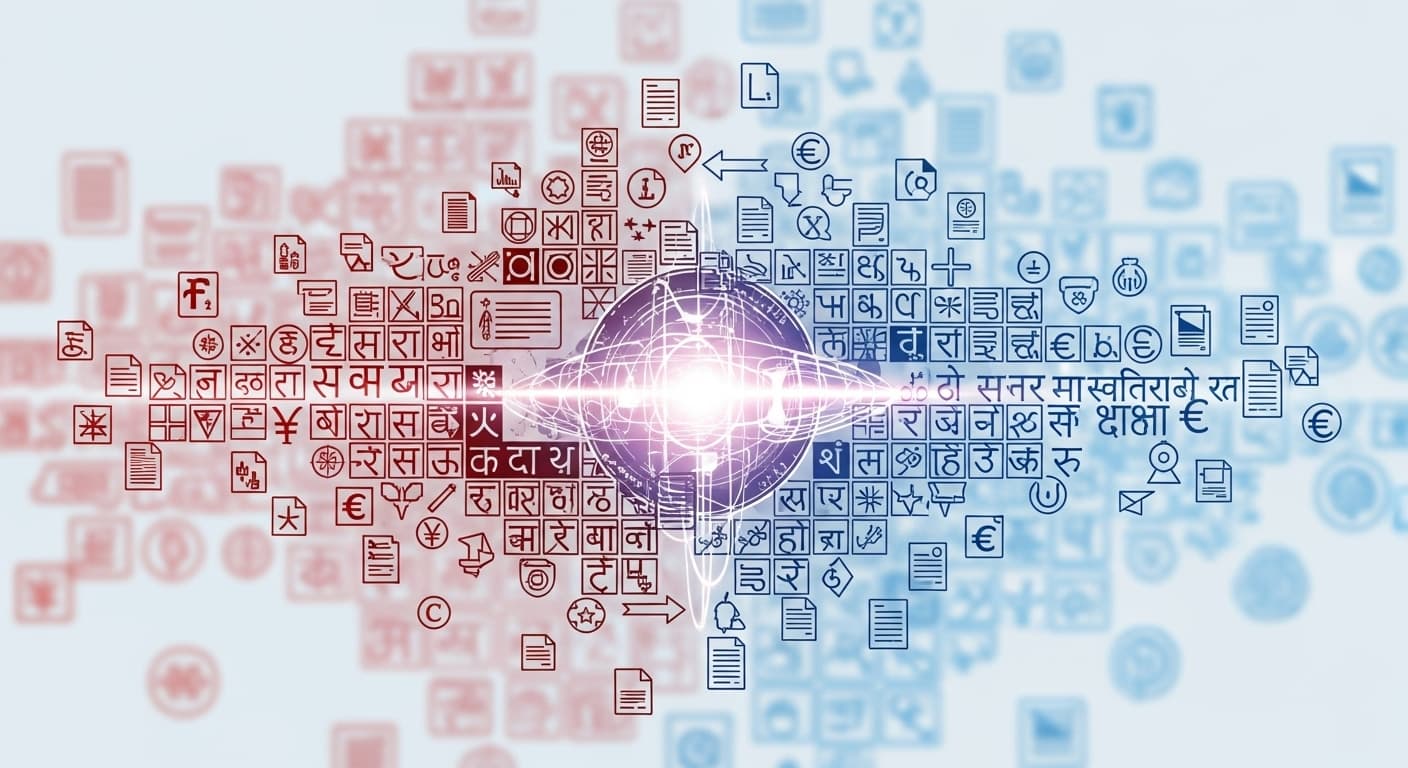
Business is global. Your vendors are in Germany, your clients are in France, and your bank statements are from Spain. But if your team is still manually typing data from foreign documents - you're missing on an automation opportunity.
Your document processing software needs to be a polyglot. But processing foreign documents correctly is much harder than it looks. It's not just about translation; it's about understanding context, formats, and layouts that change from one country to another. Our multi-language OCR technology is designed to handle these challenges automatically.
This article breaks down the real challenges of global document processing and explains how we built Suparse to solve them automatically.
The Challenge: Global Document Processing is More Than Just Translation
When a standard OCR tool tries to read a non-English document, it often fails. That's because the challenge isn't just about language; it's about structure. True international invoice processing requires an AI OCR that understands these regional differences.
Different Character Sets and Scripts
The first hurdle is the text itself. Many languages use diacritics (like the é in French or ü in German) or entirely different scripts like Cyrillic or Greek. Basic OCR systems trained only on standard English can't perform proper character recognition, leading to errors in data.
Conflicting Date and Number Formats
Is 07/08/2024 July 8th or August 7th? In the US, it's the former. In Europe, it's the latter. An OCR that gets this wrong can cause errors in accounting systems and financial reporting.
The same issue applies to numbers. A German invoice for 1.234,56 € is one thousand, two hundred thirty-four euros and fifty-six cents. A US system might misread that as just over one euro.
Varying Keywords and Terminology
Your current software is probably looking for the word "Invoice" or "Faktura". But in France, it's a Facture. In Germany, it's a Rechnung. In Spain, a Factura. Without the ability to recognize these local keywords, an automated system will fail to even classify the document correctly, let alone extract data.
The Old Way: Manual Language Selection
Some tools attempt to solve this by making you do the work. They provide a dropdown menu where you have to manually select the document's language before every upload. This is slow, error-prone, and completely defeats the purpose of automation when you're dealing with documents from dozens of countries.
The Suparse Difference: A Truly Global AI Model
At Suparse, we knew the manual approach wasn't good enough. That's why our AI wasn't just trained on English documents. It was trained on millions of financial documents from over 100 countries.
The result is a system that doesn't just translate; it understands the financial language and structure of each region. This capability is essential for global logistics processing where documents come from every corner of the world.
From Foreign PDF to Standardized Data in Seconds
Suparse doesn't just extract data-it intelligently normalizes it into a clean, consistent, and machine-readable format. This means you can stop worrying about regional differences and start using your data.
Go Global Without the Headaches
Stop fighting with language barriers and letting international documents disrupt your workflow. True automation means having a system that is as global as your business. By understanding the language, format, and context of any document automatically, Suparse eliminates the manual work, reduces costly errors, and gives you back the time you need to focus on your business. For example, our system can process air waybills from international carriers with high accuracy.
Go Global with Your Automation
Tired of language barriers in your documents? Upload an international invoice or bank statement and see our multi-language AI in action. Test with 50 free pages, no credit card required.
Test Our Intelligent OCR for FreeFrequently Asked Questions About Multi-Language Document Processing
Do I need to tell Suparse the document's language before uploading?
No, you don't. This is our key advantage. Suparse's AI automatically detects the language of any document you upload without any manual selection or pre-configuration.
Can you extract data from a scanned German invoice or a photo of a Spanish bank statement?
Absolutely. Our AI OCR is designed to extract data from various sources, including scanned documents and images, not just native PDFs. Suparse can read a german invoice or a spanish bank statement.
What about languages that read from right-to-left (RTL), like Arabic or Hebrew?
Yes, our system supports right-to-left languages. The AI is trained to understand the layout, text direction, and structure of these documents.
Is there an API for automating international invoice processing?
Yes, Suparse offers a comprehensive solution that allows you to programmatically automate international invoice processing. Sign up for a free API key from your dashboard to get started.
What file formats do you support for upload?
You can upload documents in multiple formats, including PDF (both native and scanned), JPG, and PNG.
How does the data normalization work for different countries?
Our AI automatically recognizes the document's locale and standardizes key information. For example, it converts all dates to your preffered format and standardizes decimal and thousand separators for numbers.
Michal Raczy
Michal is the founder of Suparse.com. He has over 15 years of experience in delivering projects in data analysis, automation, and document processing. Michal solves complex automation and AI implementation challenges for both SMEs and large corporations, with a particular focus on document processing. Contact at michal@suparse.com.