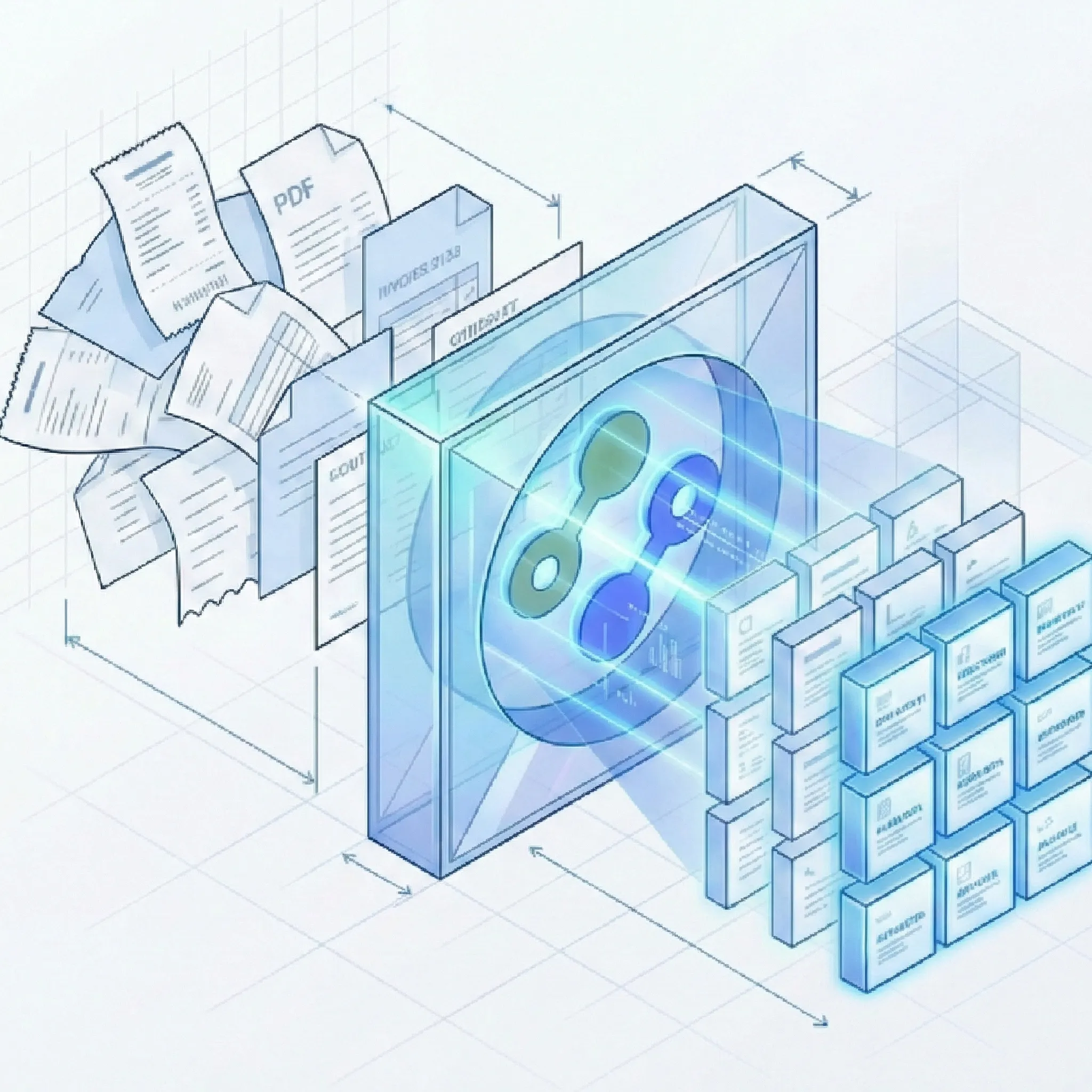
Parseur is a strong fit when your workflow starts in an inbox and needs no-code parsing, templates, and broad automation connectors. Suparse is better when finance, operations, or product teams need template-free extraction from PDFs, scans, invoices, bank statements, logistics documents, tax forms, and custom documents through a UI, REST API, Python SDK, or TypeScript SDK.
Python and TypeScript SDKs
Custom document schemas
JSON, Excel, CSV, QBO, IIF
50 free page credits
Quick Summary
Criteria
Suparse
Parseur
Best for
Finance, logistics, operations, and developer teams that need structured extraction from business documents and custom PDFs.
SMBs and operations teams that want email-native parsing, attachment intake, no-code automations, and many connector options.
Pricing model
Published page-based monthly subscriptions start at $11/month for 100 pages, with yearly discounts available.
Parseur's 2026 support pricing lists a free tier and paid monthly plans from Micro 100 at $49/month, with higher tiers up to 30,000 credits at $1,299/month.
Free trial
50 free page credits with no credit card required.
Free tier is listed as 20 credits or up to 20 pages per month, with no credit card required on common software directories.
Time to first extraction
Self-service signup and first extraction in under 60 seconds.
Fast for simple email and document workflows, especially when a standard mailbox or template flow matches the incoming format.
SDK
REST API plus Python and TypeScript SDKs for developer integration.
REST API plus an official Python client and CLI; TypeScript teams typically integrate through the REST API.
Schema flexibility
Create or edit custom extraction schemas in the UI, including fields, tables, and validation rules.
Supports AI field descriptions and visual templates, with strong fit for no-code extraction setup.
Template requirements
Template-free extraction with pre-trained models and AI-assisted schema generation.
Uses a hybrid model: AI parsing plus templates for precision, so stable layouts and email formats are still an important fit.
Deployment model
Cloud SaaS with VPC or on-premise options for controlled deployments.
Cloud SaaS; Parseur's own comparison content notes that on-premise or air-gapped requirements may need another solution.
Review workflow
Human-in-the-loop review, correction, validation checks, team access, and audit trail.
Useful for checking parsed data, enforcing mailbox schema rules, and maintaining templates, with less emphasis on finance-specific reconciliation.
Export options
Excel, CSV, JSON, Google Sheets, QBO, IIF, Xero-compatible CSV, and API output.
Strong automation exports, including CSV, JSON, Excel export URLs, Zapier, Make, n8n, Power Automate, native webhooks, and REST API.
Team access
Unlimited user seats are included with every subscription.
Team access and high-volume packaging should be checked against the current Parseur plan because pricing is credit or page-volume based.
Full Feature Comparison
Compare email and document intake, integration options, SDKs, custom schemas, review, and exports against your workflow needs.
Capability
Suparse
Parseur
Structured JSON output
API responses are designed for structured extraction workflows and downstream systems.
Parseur supports structured output through JSON, CSV, webhooks, integrations, and REST API workflows.
Email parsing
Dedicated email addresses process attachments, the email body, or both. Choose a document type or Email Autopilot; unmatched documents go to review without automatically creating a new type.
Email parsing is one of Parseur's clearest strengths, including body, attachment, and metadata-driven workflows.
Invoice and receipt presets
Invoices and receipts are available as ready-to-use document models.
Parseur says its AI engine works with all document types; use case pages and examples commonly include invoices, orders, leads, and operational documents.
HTML, Word, spreadsheet, and web page ingestion
Suparse focuses on documents, scans, PDFs, PNGs, and JPEGs rather than HTML, Word, spreadsheets, or web page ingestion.
Parseur supports emails, PDFs, scans, images, HTML and text files, Word documents, Excel or CSV spreadsheets, and web pages.
Bank statement support
Extracts statement-level data and transactions, with reconciliation checks.
Parseur can parse many PDFs and attachments, but bank-statement reconciliation is not a highlighted Parseur strength.
Tax form and financial document support
Supports tax forms, checks, energy bills, and other financial documents through presets or custom schemas.
Parseur handles varied documents, but finance-specific extraction presets and validation should be checked for each document type.
Custom document schemas
Users can create new schemas with AI assistance or extend pre-trained models.
Parseur supports custom extraction through AI field descriptions and visual templates.
Template-free zero-shot extraction
Handles new layouts without per-vendor template setup or model training.
Parseur has three engines: AI parsing, template-based OCR for PDFs and images, and template-based text parsing for emails and text documents.
No model training required
Start with presets or define fields directly in the UI without labeled training sets.
Parseur marketing says no model training is required; deeper technical docs position setup around AI instructions and templates rather than labeled model training.
Automatic adaptation to layout changes
Designed to adapt when vendor layouts change.
AI parsing can handle variation, but template workflows use one template per layout and may need additional templates when formats change.
Handwriting recognition in 100+ languages
Supports handwriting and multilingual extraction across more than 100 languages.
Parseur claims OCR for 200+ languages and handwriting, while some language coverage is described as experimental.
Scanned and degraded document support
Supports PDFs, scanned documents, low-quality scans, faxes, and mobile photos.
Parseur supports OCR for PDFs, scanned documents, and attachments.
Complex table extraction
Extracts borderless, variable-row, and multi-page tables including invoice line items.
Parseur can extract structured data from varied files, but complex or changing tables may require AI instructions or template maintenance.
Automatic document classification
Can classify documents and route them to the correct schema.
Parseur routes documents through mailbox, AI, template, and automation workflows; broad mixed-document classification should be validated for your exact setup.
Automatic multi-document PDF splitting
Splits mixed PDFs into individual documents before extraction. No additional splitting fee; standard extraction page charges apply.
Parseur splits PDFs over 500 pages into 500-page chunks after upload; that is not the same as business-level multi-document splitting.
Long document auto-chunking
Auto-chunking supports long multi-page documents.
Parseur's AI engine works best up to about 100 pages, while template engines list no page limit; PDFs over 500 pages are chunked.
File and upload limits
Suparse supports PDFs, PNGs, JPEGs, scans, and multi-document PDFs; unusually large batches should be checked against account limits.
Parseur lists 35 MB email limits, 20 MB PDFs for 10 pages or less, 256 MB for longer PDFs or direct uploads, and image dimension limits.
Python SDK
Python SDK is available for API-based extraction.
Parseur provides an official Python client and CLI called parseur-py.
TypeScript SDK
TypeScript SDK is available for JavaScript and TypeScript applications.
Parseur has REST API access and no-code connectors, but its documented client-library path is Python rather than TypeScript.
REST API
REST API supports upload, status polling, and result retrieval.
Parseur's API can create mailboxes, set fields and AI instructions, attach webhooks, upload files, submit email or text payloads, and poll documents.
Native webhooks
Send extracted results to your HTTPS endpoint when processing completes. Subscribe by document template and upload source to connect your systems and workflows.
Parseur supports native webhooks that POST extracted JSON, can use custom headers, and can be configured in-app or through the API.
Zapier, Make, and Power Automate
Suparse does not currently provide native Zapier, Make, or Power Automate connectors.
Parseur documents automation routes for Zapier, Make, n8n, and Power Automate.
Spreadsheet input behavior
Suparse does not currently parse Excel or spreadsheet files as uploaded input files.
Parseur supports spreadsheets, but official docs say it processes only the first tab and has a 512-character column-name limit.
Self-service signup
Users can sign up and buy online.
Parseur is self-service and designed to start without a required sales process.
Under 60 seconds to first extraction
Built for immediate testing on real documents.
Parseur can start quickly for simple workflows, but template-based setups can take longer for complex documents.
50 free page credits with no credit card
The free test is credit-based and does not require a card.
Parseur lists a free tier as 20 credits or up to 20 pages per month; common software directories list no credit card required.
Month-to-month subscription
Month-to-month plans are available, with lower pricing for annual commitment.
Parseur's 2026 support pricing lists monthly tiers from $49/month for 100 credits to $1,299/month for 30,000 credits.
No setup or implementation fee
No required implementation services; optional consulting is available.
Parseur is positioned as no-code and self-service, without a required implementation project.
Unlimited user seats
Unlimited seats are included with every subscription.
Team access and high-volume packaging should be checked against the current Parseur plan before scaling.
Full audit trail for edits and extractions
Tracks extraction and user edits for review workflows.
Parseur documents document logs and webhook logs; full business-level edit audit requirements should be tested.
Batch processing
Supports bulk upload and parallel processing.
Parseur supports API uploads and automation at scale, with file and page limits that vary by input type and engine.
Human-in-the-loop review UI
Review extracted fields alongside the original document before export.
Parseur surfaces schema, required-field, and choice-field validation failures in the UI and can send notifications or webhooks.
Bank statement reconciliation
Validates opening balance plus transactions against closing balance.
Parseur does not position native bank statement reconciliation as a documented product capability.
Invoice self-consistency checks
Can check subtotal, tax, and total consistency before export.
Parseur validates extracted data against mailbox schemas, required fields, and choice fields; invoice math rules are not its main positioning.
Confidence scores per field
Suparse does not currently expose per-field percentage confidence scores.
Parseur emphasizes schema validation and logs rather than per-field confidence scoring.
Source highlighting or traceability
Suparse does not currently provide click-to-highlight bounding boxes on the original document.
Parseur documents a Source view for hidden HTML attributes, but that is not the same as per-field provenance highlighting.
Fraud detection and duplicate detection
Suparse does not currently provide fraud detection or duplicate document detection.
Parseur focuses on extraction and routing rather than native fraud detection or duplicate checking.
Direct accounting integrations
Suparse exports QBO, IIF, CSV, Excel, Google Sheets, JSON, and API data, but does not offer one-click accounting pushes yet.
Parseur has broad automation connectors, but direct accounting behavior depends on the connected app or automation workflow.
Export to Excel, CSV, JSON, QBO, and IIF
Suparse supports export-ready formats for spreadsheet, accounting import, and API workflows.
Parseur supports CSV, JSON, and Excel export URLs plus webhooks and connectors; QBO and IIF are not its standard export positioning.
Google Sheets export
Suparse can export extraction results to Google Sheets.
Parseur is strong for spreadsheet-style export and automation workflows, but Google Sheets support should be checked against the current integration list.
Cloud SaaS with VPC/on-premise option
Cloud is the default, with VPC or on-premise options for controlled deployments.
Parseur is cloud-native; Parseur's own content says on-premise or air-gapped requirements may need another solution.
EU hosting
EU-focused hosting supports GDPR and data sovereignty needs.
Parseur says its servers are located in the European Union in a data center complying with ISO 27001.
No customer data used for model training
Customer documents are not used to train public AI models.
Parseur publishes GDPR and data deletion commitments, but buyers should confirm how AI processing data is handled for their account.
Zero-retention option
Available for customers that require documents to be deleted after processing.
Parseur says customer data can be deleted at any time, removed immediately from servers, and removed from logs and backups within 45 days max.
GDPR compliance
Suparse is built for GDPR-compliant document processing.
Parseur publishes GDPR commitments for its hosted service.
No email-parser lock-in
Use extracted data in spreadsheets, APIs, ERPs, accounting imports, or internal systems without making email the center of the workflow.
Parseur's email-native design is a strength when the inbox is the workflow, and less central when documents arrive from many channels.
Pricing transparency
Public page tiers and free credits make the starting cost easy to estimate.
Parseur publishes pricing, though official pages mix credits and pages, so compare usage units carefully.
Ready to compare Suparse on your own documents?
Upload real invoices, receipts, bank statements, logistics PDFs, tax forms, or custom documents and inspect the output before committing.
Both platforms support email and document workflows. Compare native connector coverage, schema flexibility, review controls, SDKs, and export options.
From email intake to your connected workflow
Forward emails to a dedicated Suparse address and extract data from attachments, the email body, or both. Use a specific document type or Email Autopilot, with unmatched documents sent to review without automatically creating new types.
Send extraction results to your application or workflow by webhook. Subscribe by document template and upload source to route the right data to the right system. Document splitting has no additional cost; standard extraction page charges apply.
Document-first extraction
Parseur is especially useful when emails, attachments, and no-code automations are the center of the workflow. That makes it strong for order notifications, lead emails, delivery emails, and inbox-driven operations. For another email parsing alternative, our Parsio comparison covers a similar email and document parsing workflow.
Suparse is built for document-heavy teams that need clean extraction from invoices, receipts, bank statements, checks, tax forms, purchase orders, bills of lading, air waybills, delivery notes, resumes, prescriptions, and custom PDFs.
Custom schemas without template upkeep
Parseur gives teams both AI parsing and templates, which is useful when stable documents need a point-and-click workflow. The tradeoff is that template maintenance can become part of the operating model when layouts vary.
Suparse lets users create or edit schemas in the UI, define custom fields and tables, and process new layouts without building a separate template for every vendor format.
SDK-first developer experience
Parseur is strong for no-code integrations, native webhooks, REST API access, and an official Python client. Suparse is designed for teams that want document extraction embedded inside their own app, data pipeline, or operational backend with both Python and TypeScript SDKs.
Developers can use the REST API, Python SDK, or TypeScript SDK to upload documents, poll status, and retrieve structured JSON.
Parseur exports parsed data through CSV, JSON, Excel export URLs, automation tools, webhooks, and APIs. That is ideal when the next step is a no-code workflow or custom webhook endpoint.
Suparse adds document-specific review and validation, including bank statement reconciliation, invoice self-consistency checks, unified Excel and CSV exports, JSON, Google Sheets, QBO, IIF, and Xero-compatible CSV.
Controlled deployment options
Parseur is a cloud-native product, and its own alternative page notes that highly sensitive on-premise or air-gapped requirements may need a different solution.
Suparse is cloud SaaS by default and also offers VPC or on-premise options for organizations that need tighter deployment control.
When Parseur Is the Better Choice
Parseur remains a strong option when your automation begins in email and you want a mature no-code parser with broad connector coverage.
Choose Parseur if email header and metadata extraction is central to your parsing workflow.
Choose Parseur if your team wants Zapier, Make, n8n, Power Automate connectors alongside REST API automations and an official Python client.
Choose Parseur if your documents and emails follow a small number of stable formats and a template workflow is easy to maintain.
Choose Parseur if you need to ingest HTML, Word documents, spreadsheets, web pages, or rich email content.
Choose Parseur if non-technical users need to build and manage parsing rules without involving developers.
Choose Parseur if your current inbox-driven workflow is already working and you do not need private deployment, QBO or IIF exports, or finance-specific reconciliation. Our Docparser comparison covers another no-code parsing option with strong Zapier integration.
Frequently Asked Questions
Is Suparse better than Parseur?
Suparse is a strong fit when you need email body and attachment parsing alongside custom document schemas, SDKs, validation, webhooks, and export-ready data. If you are looking for a Parseur alternative that supports Python and TypeScript SDKs, Suparse is a stronger fit for developer-led document extraction. Parseur is a stronger fit when you need its native no-code connectors, email metadata extraction, or broader input formats.
Is Suparse cheaper than Parseur?
Suparse has public page-based pricing, starts at $11/month for 100 pages, and includes 50 free page credits without a credit card. Parseur's 2026 support pricing lists a free tier and paid monthly plans from $49/month for 100 credits, but official pages mix credits and pages, so compare usage units carefully.
Can I migrate from Parseur to Suparse?
Yes, but migration is not a one-click copy. You should map Parseur fields to Suparse schemas, test representative emails and documents, configure dedicated Suparse email addresses for the document types you need, and compare the output shape against what your downstream tools expect.
Does Suparse support email parsing like Parseur?
Yes. Suparse provides dedicated email addresses for a specific document type or Autopilot. Parse attachments, the email body, or both, and send extracted results to your workflow by webhook. Email Autopilot can match workspace types or include shared system types; unmatched documents go to review without creating new types automatically. Compare Parseur separately if you need email header or sender metadata extraction.
Does Suparse support the same document types as Parseur?
No. Suparse supports invoices, receipts, bank statements, checks, tax forms, purchase orders, bills of lading, air waybills, delivery notes, resumes, prescriptions, and custom documents. Parseur supports a broader set of input containers, including emails, PDFs, scans/images, HTML or text files, Word documents, spreadsheets, and web pages.
Does Suparse integrate with Zapier, Make, or Power Automate like Parseur?
Suparse does not currently provide native Zapier, Make, n8n, or Power Automate connectors. Suparse supports webhooks for sending extraction results to your workflow, plus REST API, Python and TypeScript SDKs, and spreadsheet exports. Parseur is stronger when you need those native no-code connectors.
How does Suparse handle data privacy and GDPR compared with Parseur?
Suparse offers EU hosting, GDPR compliance, encryption in transit and at rest, no customer-data model training, user-managed deletion, and an optional zero-retention setup. Parseur says its servers are in the European Union in an ISO 27001-compliant data center and that deleted data is removed from logs and backups within 45 days max; buyers should confirm how AI processing data is handled for their account.
Does Suparse work without a Parseur account?
Yes. Suparse is a standalone document extraction platform, so you do not need a Parseur account or an email parsing workflow to process documents.
What languages does the Suparse SDK support?
Suparse provides Python and TypeScript SDKs, plus REST API documentation. That makes it practical for backend services, internal tools, data pipelines, and SaaS applications that need document extraction.
Try Suparse on your own documents
Use real documents to compare extraction quality, review effort, schema flexibility, and export readiness.